Almost there!
This website works best on desktop or mobile.
Tablet support isn’t available yet — please switch devices to continue.
Duration
2 . 5 months

My Role
Lean UX Practitioner | UX researcher |
Market research Analyst | Business Strategist | Experience Designer |
Interaction Designer | UX Evaluator
Second Cycle is a sustainable fashion app which aims to address the detrimental effects of impulse purchasing and hoarding, with the focus on helping users make mindful choices and increase environmental awareness.
Designed to create a Minimum Viable Product, Second Cycle follows the Lean UX process, ensuring an iterative approach that effectively balances user-centric design with business objectives.
A Lean UX case study
SecondCycle
The Problem
The Need vs Want Dillema
Driven by a false sense of urgency, impulse purchases often provide immediate satifsaction, only to leave people regretting their decisions afterward.
Unnecessary Clutter and Waste
As most impulse purchases are deemed unnecessary, they often lead to hoarding which ultimately results in wasted resources, thus negativily imapcting sustainability efforts.
The accumulated cost of small purchases
These unplanned purchases may seem harmless at first, but they quickly add up—the pennies that steal the pound.
Research
My research focused on understanding how individuals with impulse-buying and hoarding tendencies make their purchases, their decision-making criteria, and identifying strategies to tackle these issues.
I also carried out secondary research focused on Consumer behaviour, Market research and Technology research.

Think
Drawing from the primary and secondary research findings, I listed some user and business assumptions and prioritised them to guide feature development and problem-solving. To understand user needs, I created user personas and journey maps. Finally, I created the service blueprints and a mental model to define the scope of the app.


User and Business Assumptions
-
User assumptions focused on user needs and prioritising features.
-
Business assumptions focused on aligning with business objectives and market viability.
Assumption Prioritisation
I plotted these assumptions in the Importance vs Evidence matrix to decide which assumptions to focus on while designing the MVP for SecondCycle.
The main areas of focus were quadrants 1 and 2:
-
Quadrant 1 included the risky assumptions that needed to be tested and
-
Quadrant 2 included the strongest assumptions that would help in ideating the fundamental features of the MVP.

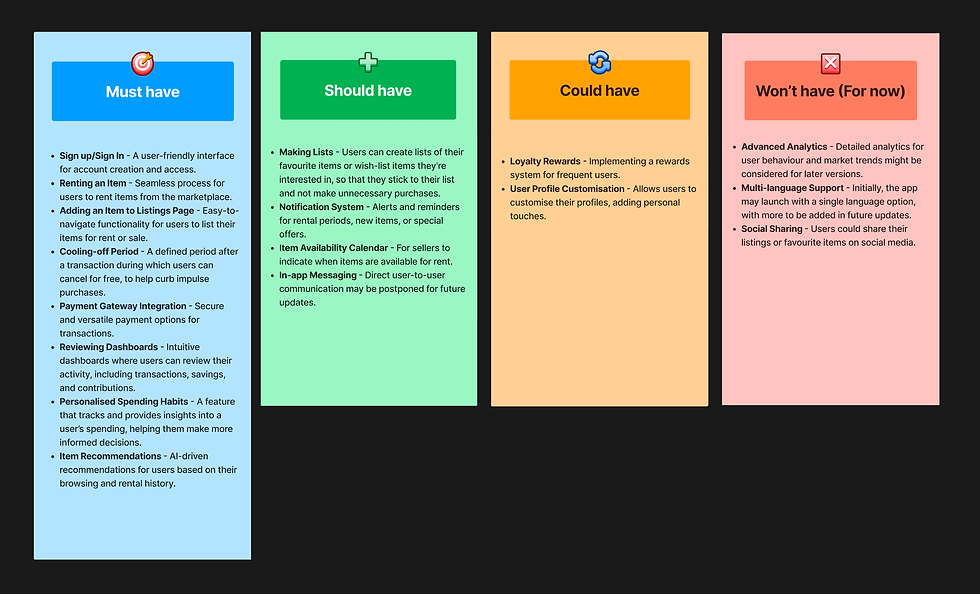
MOSCOW Prioritisation
MOSCOW prioritisation (Must Have, Should Have, Could Have, Would Have) further helped with giving a clearer idea of what features must be focused on as per their importance and evidence from the assumption prioritisation chart.
Personas and their Customer Journey Maps


Service Blueprint
-
Turning to the business aspect of the project, I created two service blueprints, which focus on creating user-centric services - one for the buyer and one for the seller.

-
The other stakeholders include service employees (delivery partners), logistics partners (for maintaining operational efficiency) and environmental regulatory bodies (to ensure that the platform adheres to sustainability, quality and legal standards).

Mental Model
In this final step of the ‘Think’ phase, I used a Mental Model canvas template to map out the users’ interactions with the app in terms of their beliefs, previous experiences and expectations.

Make
I outlined six hypotheses and prioritised them to turn my assumptions into testable ideas. This helped me finalise the features that would make it to the app and those that might be reconsidered later, and start prototyping.

Hypotheses and their prioritision
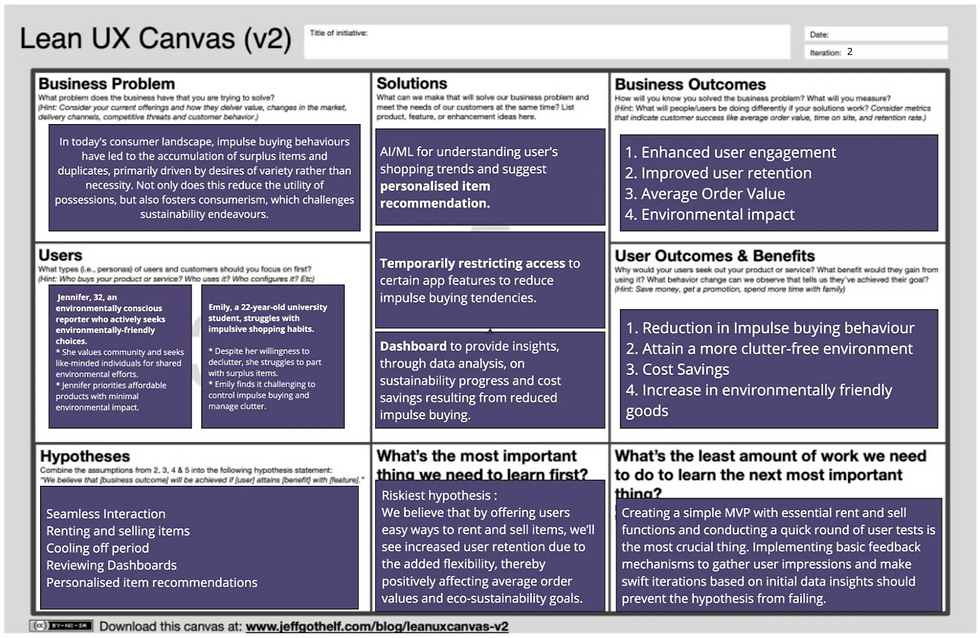
Writing these hypothesis statements gave me a sense of clarity and direction while reiterating the need to check if my solutions aligned with user needs and business goals.

Lean UX Canvas
Task 1
Purchase an item
-
We believe that implementing a cooling-off period will lead to a reduction in impulse buying, as users will have the time to reconsider their purchases, thus aligning with our goal of fostering mindful shopping habits.
-
We believe that providing AI-driven recommendations based on browsing and rental history will lead to increased customer engagement and environmental impact by suggesting items that align with users' existing preferences, reducing the need for new production.
Hypotheses
Performance Data

Since all the participants passed the task, and the feedback they gave, the hypotheses
are verified with 100% success rate.
Solving the problem through
Hypotheses Validation & Testing
The Cooling-Off Period
Hit pause before you checkout.
The item will be reserved for a period of 24 hours, so you get some time to reconsider your purchase.
Please switch over to the desktop browser to view the full solution.
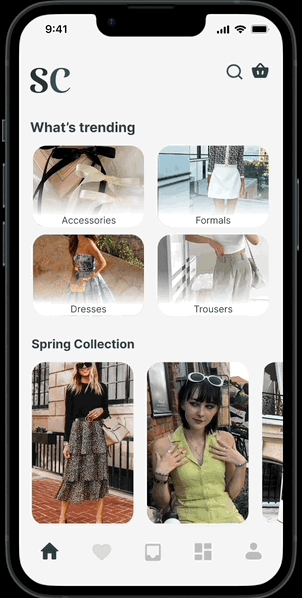
Try it before you buy it
Rent an item to see if it is worth owning, and help reduce resource waste.
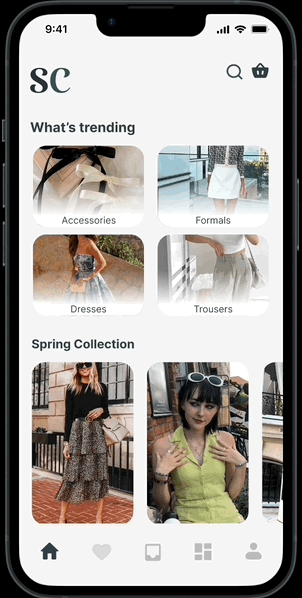
Task 2
Rent an item
-
We believe that by offering users easy ways to rent and sell items, we’ll see increased user retention due to the added flexibility, thereby positively affecting average order values and eco-sustainability goals.
-
We believe that offering a seamless and user-friendly sign-up and sign-in process will enhance user engagement by simplifying the entry point into the app, encouraging frequent use and exploration of its features.
Hypotheses
Performance Data

Since all the participants passed the task, and the feedback they gave, the hypotheses
are verified with 100% success rate.
Task 4
Add an item to Listings
-
We believe that by offering users easy ways to rent and sell items, we’ll see increased user retention due to the added flexibility, thereby positively affecting average order values and eco-sustainability goals.
-
We believe that easy-to-navigate functionality for listing items will lead to an increase in average order value as users become more active on the platform, both as buyers and renters.
Hypotheses
Performance Data

Since all the participants passed the task, and the feedback they gave, the hypotheses
are verified with 100% success rate.
Turn the Clutter to Cash
Give your unused/ hoarded items a second life - sell or rent them out to help others shop mindfully while promoting circular fashion.
